Fifa opens disciplinary proceedings against Argentina over Falklands banner and final incidents

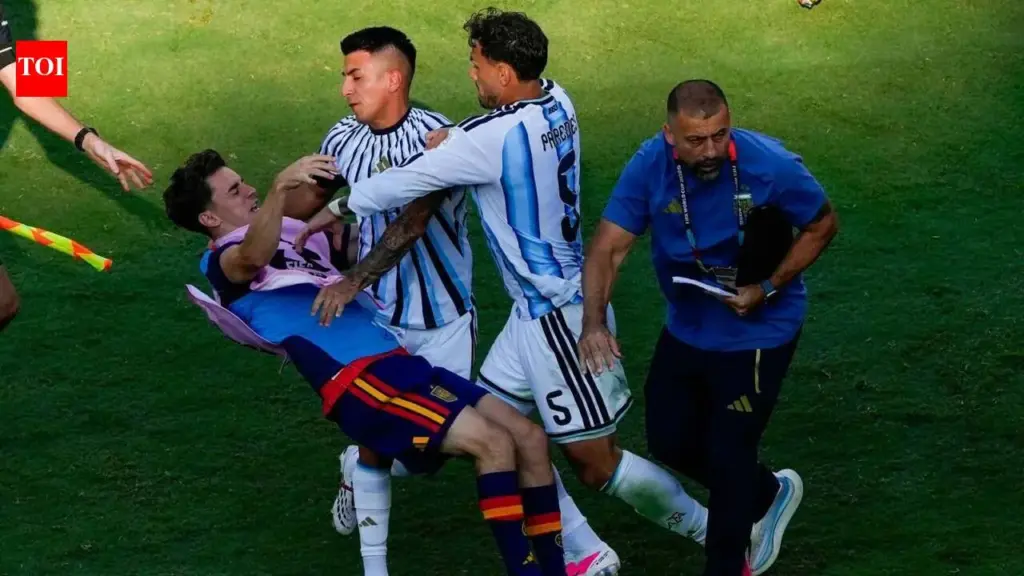
Fifa has initiated disciplinary proceedings against Argentina, the Argentine Football Association (AFA), and several players and coaching staff following incidents during and after the 2026 Fifa World Cup. The charges relate to a banner displayed after their semi-final victory, as well as chaotic scenes that occurred after their defeat in the final.
Following Argentina’s 2-1 semi-final win against England in Atlanta, several players were seen holding a banner. This banner proclaimed, “Las Malvinas son Argentinas,” referencing the Falkland Islands, known as the Islas Malvinas in Argentina. This act is considered a breach of Fifa’s disciplinary code, which prohibits “using a sports event for demonstrations of a non-sporting nature.” The dispute over these islands, which have been under British rule since 1833, has been ongoing and led to a 74-day conflict in 1982, resulting in over 900 fatalities.
This is not the first instance of an Argentina team expressing such sentiments. In 2014, Fifa imposed a fine of £20,000 on Argentina for a similar, larger banner displayed by players before a friendly match against Slovenia in La Plata. The recent banner prompted political discussion, with a spokesperson for the then UK prime minister stating, “The World Cup might not be ours, but the Falkland Islands definitely are.” Conversely, Andrew Giuliani, head of the White House Fifa taskforce, defended the Argentine players, citing the US belief in free speech.
Charges Related to World Cup Final
The disciplinary action also covers events that transpired after Argentina’s 1-0 extra-time loss to Spain in the final. As Spain attempted to celebrate their victory, altercations reportedly broke out across the pitch at New York New Jersey Stadium. Several Argentine players and coaching staff are under investigation for their involvement in these incidents.
Argentina midfielder Leandro Paredes is facing three counts of assault under Article 14 of the Fifa Disciplinary Code. He was reportedly seen wrestling Spain’s Eric García to the ground and is alleged to have grabbed and pushed Spain players, including García and Gavi, during the post-match altercation. Defender Nahuel Molina faces two counts of assault, one completed and one attempted, after allegedly striking Spain captain Rodri. Molina also faces an additional charge of unsporting behaviour.
Assistant coach Roberto Ayala has been charged with one count of assault for his involvement in the confrontation. Additionally, Thiago Almada, who was an unused substitute in the final, faces one count of unsporting behaviour. Spain’s Gavi is also under investigation and has been charged with one count of unsporting behaviour arising from the same incident.
Additional Breaches and Next Steps
The comprehensive charge sheet against the Argentine Football Association extends beyond the banner incident and the final’s aftermath. Fifa is also investigating several other alleged breaches that occurred throughout the tournament. These include alleged discriminatory chants and gestures by Argentina supporters and the throwing of objects by spectators during multiple matches. Furthermore, the AFA faces charges related to alleged failures in match organisation and security protocols, as well as team misconduct linked to the mass confrontation after the World Cup final.
All individuals and entities charged have been given the opportunity to present their position to Fifa. Following this, the Fifa Disciplinary Committee will issue its decisions. If found guilty, players could face match suspensions and financial penalties. Assault offences under Fifa’s disciplinary regulations can lead to bans of at least three matches, while unsporting behaviour may result in a minimum one-match suspension. The formal charge regarding the banner was specified as “using a sports event for demonstrations of a non-sporting nature.”
The Fifa Disciplinary Committee will review these matters separately and issue a decision in due course.
Source: theguardian.com

